
Should I sell on Alibaba or Amazon?
Compare in detail whether to sell on Alibaba or Amazon. The roadmap helps businesses choose the right platform to optimize costs, protect capital flows and export successfully.
Ta Thi Minh Phuong
Author
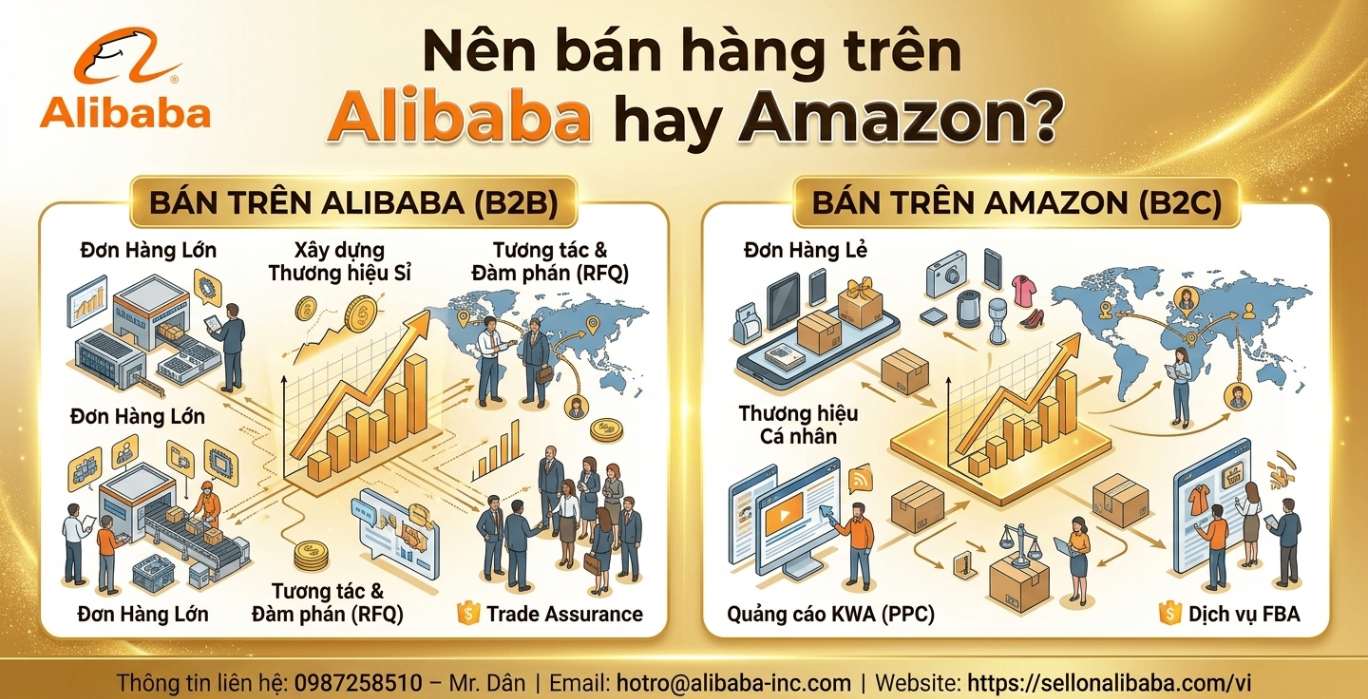
In the wave of digital transformation and international economic integration, cross-border e-commerce has become a strategic launch pad to bring "Made in Vietnam" products to the world. Facing this great opportunity, most small and medium-sized enterprises (SMEs), factory owners and startups are faced with a difficult question: Should they sell on Alibaba or Amazon?
Both of these platforms are giants that dominate the global e-commerce industry, but they operate under two completely different business philosophies. Amazon is the mecca of B2C (Business-to-Consumer) retailing, where you directly reach the end consumer. Meanwhile, exporting through Alibaba is a pure game of the B2B (Business-to-Business) wholesale world, which connects manufacturing factories and buyers, agents, and large corporations globally.
To help you have a comprehensive view and balance between the cost of opening an Alibaba store and Amazon's operating budget, the article below will list in detail the comparison criteria, advantages and disadvantages, and the most suitable choice route for Vietnamese businesses.
1. Nature of business model: B2B and B2C
The most core difference between the two platforms lies in the customer base and how the cash and goods flow operates.
Alibaba.com– B2B model (Bulk wholesale):Customers on this platform do not buy a few products to use. They are Big Buyers, business owners, importers or distributors. They come to you to order private brand processing (OEM/ODM), buy bulk wholesale by container (FCL) or retail containerized goods (LCL). Transactions are carried out based on sending an inquiry (Inquiry), bidding for a quotation (RFQ) and signing an online commercial contract through the Trade Assurance system.
Amazon.com – B2C model (Online retail):Your customer is the final consumer who buys for personal or family use. They shop based on emotions, visual experience, reviews from previous buyers and delivery speed. Transactions take place instantly through the "Buy Now" button, sellers receive change from thousands of small orders every day.
2. Logistics and freight process
The way goods move from your warehouse in Vietnam to international customers on the two exchanges has a very clear polarization.
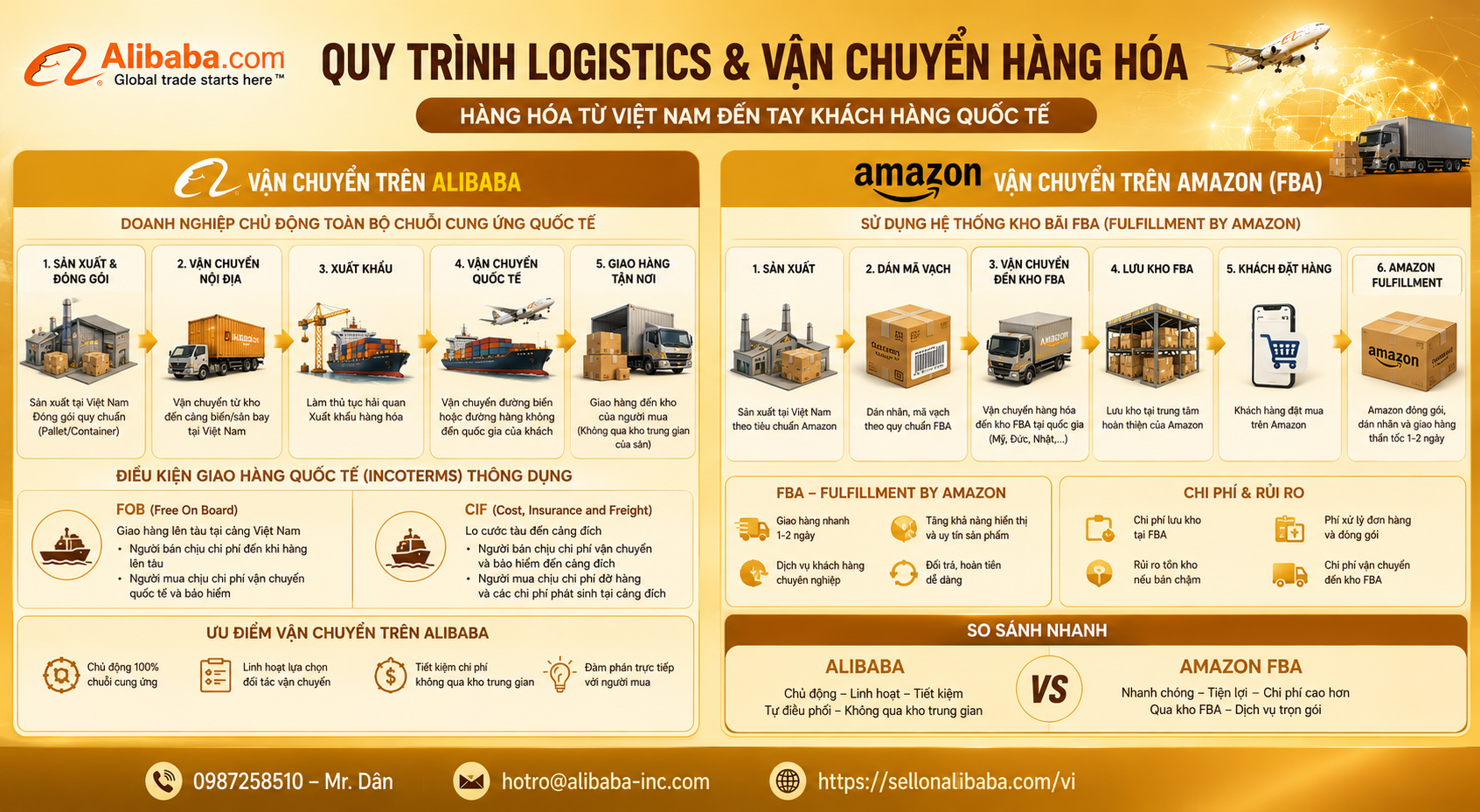
Differences in logistics between Alibaba.com and Amazon
3. The problem of initial investment costs and maintenance fees
Financial budget is always the decisive factor for businesses to choose where to place their first brick when entering the international market.
Cost on Alibaba system:This B2B platform applies a fixed annual membership fee model (Subscription fee). When businesses investAlibaba store opening costsfor packages like Gold Supplier or Verified Supplier's premium packageAlibaba Vietnam, you will pay a one-time flat fee for the entire year. The big plus is that Alibaba does not charge a commission on each of your orders. You close an order worth 10,000 USD or 100,000 USD, that money belongs to you (only a very small payment gateway processing fee).
Cost on Amazon system:The platform applies a fairly cheap monthly subscription fee model (about 39.99 USD/month for a professional account), but in return, Amazon structures a fee system that cuts deeply into the profit margin of each product. You have to pay a commission percentage on each order (usually from 8% - 15% depending on the industry), FBA storage fees calculated by volume, packaging fees, and return processing fees. If your product has a low price margin, these fees can "eat up" all your profits if not calculated carefully.
4. Marketing methods and customer outreach
The way the traffic distribution algorithm (Traffic) determines how your sales department operates on a daily basis.
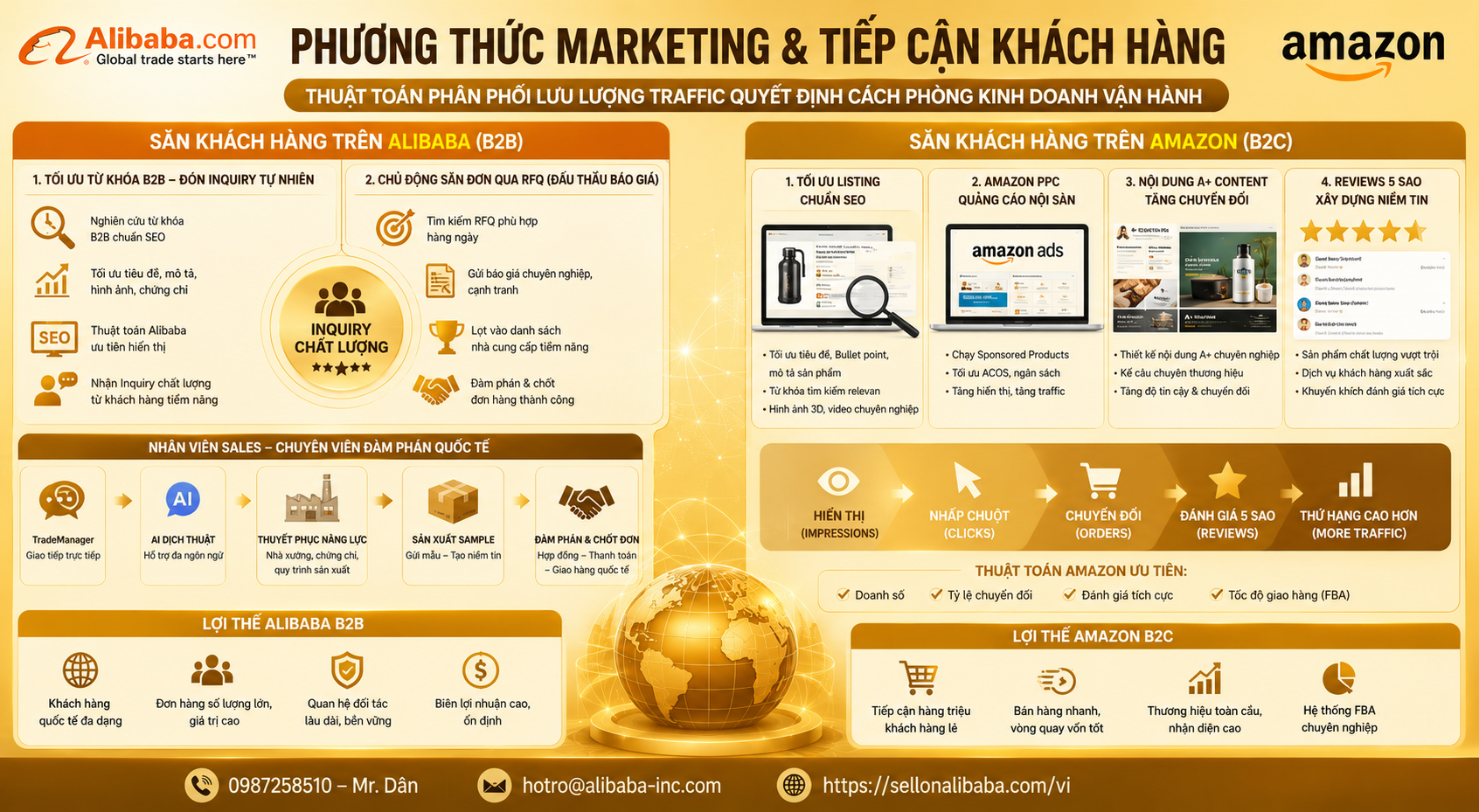
Compare marketing methods
5. Which platform is your business suitable for?
Instead of choosing according to trends, compare your business's core competencies with the criteria listed below to find the most accurate answer.
You should prioritize choosing Alibaba if:
Enterprises are factories, workshops, or trading companies with abundant and stable supply sources in Vietnam.
Your strength is on-demand processing (OEM/ODM), the ability to customize packaging, logos, and product sizes according to foreign partners' orders.
Your business goal is to wholesale, sell goods in large quantities to optimize the factory's machinery capacity and want to keep capital flow safe through traditional deposit methods or Trade Assurance.
Businesses want to own data and directly own B2B customer information to build long-term trading relationships and sign periodic supply contracts lasting many years.
You should prioritize Amazon if:
The business owns an independent retail brand (Private Label), products with unique designs, outstanding features and eye-catching packaging.
Your products belong to strong industries with compact size, light weight, and high value (such as handicrafts, gifts, fashion accessories, canned dry foods) to optimize FBA storage costs.
You have strengths in digital marketing, understand the techniques of running click ads, optimizing retail conversion rates and are able to withstand the pressure of Amazon's extremely strict consumer protection policies (such as the 30-day return policy).
Businesses want to have quick cash flow in the form of change, receive regular payments from the exchange every 2 weeks without having to go through the negotiation process and complicated export customs procedures for each small order.
Deployment solution and export launch pad for
Vietnamese businesses

Deployment solutions and export launching pad for Vietnamese businesses
Should you sell on Alibaba or Amazon? It's not a battle to decide who wins or loses, but it's a problem of finding the right fit. Choose Alibaba if you want to be a powerful industrial wholesale manufacturer supplying global chains; Choose Amazon if you want to become a retail brand loved by millions of international consumers. Positioning the right strengths, mastering technology and having a well-prepared roadmap is the universal key to help Vietnamese businesses confidently export successfully and affirm their position in the international arena.
Contact us for advice on opening a booth - Don't wait another day!
Are you in Dong Nai, Binh Duong or Ho Chi Minh City? COMPANY LIMITEDALIBABA.COMVIETNAM - ALIBABA VIETNAM is ready to support:
Head office: 19th Floor, Saigon Center Building, No. 67 Le Loi Street, Ben Nghe Ward, District 1
E-mail:[email protected]
Phone: +84 0987258510 (Mr. Dan - main consultant)
Branch 1: 10th Floor, Becamex Tower, 230 Binh Duong Avenue, Thu Dau Mot, Binh Duong
Branch 2: 9th Floor, TTC Plaza, Vo Thi Sau, Thong Nhat Ward, Bien Hoa City, Dong Nai
Branch 3:123 Cong Hoa, Ward 12, Tan Binh, Ho Chi Minh City 700000, Vietnam
Call now 0987258510 – Mr. Dan for free consultation, support in opening a booth, optimizing products and exporting plans to the West in 2026. No consultation fee, no commitment, just need you to be ready to act!
Related news

9/30/2025
Keyword Research Guide for the Furniture Industry
How to find what international customers are searching for and optimize your listings for visibility.
Read More →
9/21/2025
5 Mistakes to Avoid When Selling on Alibaba
Common pitfalls for new businesses starting out on Alibaba.com.
Read More →
10/17/2025
INSTRUCTIONS ON HOW TO SELL ON ALIBABA.COM
Are you ready to take your business to the international market? With a seller account on Alibaba.com, you can expand your business reach, reach millions of potential customers globally, and bring your products to the world. Below is a detailed guide to start your selling journey on Alibaba.com.
Read More →