
Direct vs indirect export: differences and how to choose
Direct versus indirect export: four advantages of each, five deciding factors, a comparison table and a four-step path to switch.
Ta Thi Minh Phuong
Author

Direct export suits a company that already has a stable product, one person accountable for the market, and the ability to handle documents; indirect export suits a company that is missing any one of those three. Choosing the wrong model early rarely loses orders immediately, but it does cost margin and it slows down what the company learns.
1. Where do the two models differ?
Direct export: the company signs the foreign trade contract, invoices the overseas buyer, prepares documents itself or outsources them, and receives payment straight from the partner.
Indirect export: the company sells to a domestic intermediary — a trading house, a distributor or a buying agent — and that entity resells abroad.
The core difference is not paperwork, it is three things: who owns the customer relationship, who carries the payment risk, and who gets to learn market information.
In practice the line is blurred. Many companies sell direct to a few large customers and also sell indirect through intermediaries into markets they cannot yet handle alone.
2. Four advantages of direct export
Higher margin. The intermediary's discount is gone, and that gap is usually large enough to cover the running cost of an export department.
You own customer data. You know who buys, how much, in which season, and why they leave — the information that decides product development.
You control price and positioning. No intermediary squeezing your price, and no push into the low-price segment just to make the sale easier.
You build long-term assets. Certifications, capability profiles and your own transaction history carry weight when you negotiate with new buyers.
3. Four advantages of indirect export
No export team needed. The intermediary handles documents, freight and international payment — the hardest part for a new company.
Lower payment risk. You are paid in Vietnam dong by a domestic entity, without facing currency risk or an overseas buyer who does not pay.
Fast market entry. The intermediary already has customers and already understands market standards, so the sample-to-order cycle is much shorter.
More stable volume. A large intermediary usually orders evenly, which fills capacity while you still have no direct customers.
4. Five factors that decide which model to choose
Document and international payment capability. If nobody in the company can put together an export document set and L/C is still unfamiliar, start indirect.
How stable the product is. If specifications keep changing, do not yet put your name on a contract with an overseas buyer.
Tolerance for financial risk. Direct export demands working capital: produce first, get paid later.
Margin and brand goals. If the only need is filling capacity, indirect is enough. If you need to build a brand, you must go direct.
People. One dedicated international salesperson is the minimum condition, and it cannot stay a side duty for long.
5. Quick comparison
Criterion | Direct | Indirect |
|---|---|---|
Margin | Higher | Lower, in exchange for simplicity |
Payment risk | High, depends on the overseas buyer | Low, paid domestically |
Staffing requirement | A dedicated person needed | Not mandatory |
Time to market | Long, learning from scratch | Short |
Customer ownership | Yours | The intermediary's |
Control of final selling price | Yes | Limited |
Risk of losing the channel | Low | High with only one intermediary |
6. Path from indirect to direct
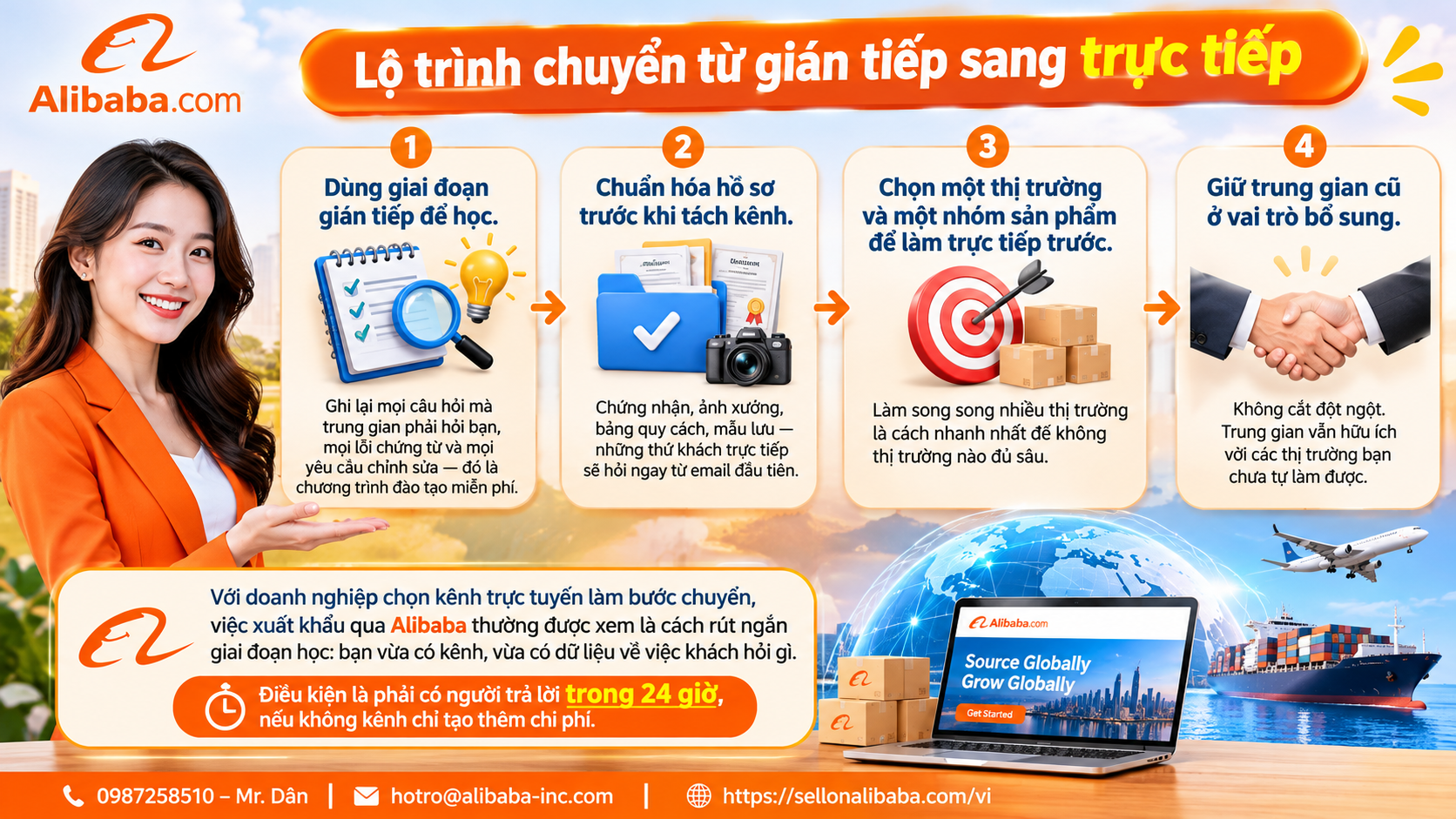
Roadmap for direct export innovation
For companies using online channels as the stepping stone, export through Alibaba is often seen as a way to shorten the learning phase: you get a channel and you get data on what buyers ask. The condition is having someone who answers within 24 hours, otherwise the channel only adds cost.
7. FAQ
Which model should a new company start with? Indirect, if you have no one doing documents and no working capital for a first international order.
Does indirect export cost you the chance to build a brand? Yes, if it drags on. Intermediaries usually require selling under their label, so your brand recognition does not accumulate.
Can a company do both at once? Yes, and most mid-sized companies do. Define clearly which market goes through which channel to avoid price disputes.
When should you move fully to direct? When at least one direct customer buys repeatedly, and your document set has run correctly on three consecutive shipments.
8. Conclusion
Choosing an export model means choosing how much risk the company accepts in exchange for margin and customer ownership. The pragmatic rule: use indirect to learn, move to direct once the file and the people are ready.
Talk to an advisor
ALIBABA.COM VIETNAM CO., LTD — ALIBABA VIETNAM
Head office: 19th Floor, Saigon Centre, 67 Le Loi Street, Ben Nghe Ward, District 1, Ho Chi Minh City
Branch: 10th Floor, Becamex Tower, 230 Binh Duong Boulevard, Thu Dau Mot, Binh Duong
Branch: 9th Floor, TTC Plaza, Vo Thi Sau Street, Thong Nhat Ward, Bien Hoa, Dong Nai
Call 0987258510 — Mr. Dân for a free consultation on choosing an export model and a route onto B2B channels. Call 0987258510 — Mr. Dân
Related news

9/30/2025
Keyword Research Guide for the Furniture Industry
How to find what international customers are searching for and optimize your listings for visibility.
Read More →
9/21/2025
5 Mistakes to Avoid When Selling on Alibaba
Common pitfalls for new businesses starting out on Alibaba.com.
Read More →
10/17/2025
INSTRUCTIONS ON HOW TO SELL ON ALIBABA.COM
Are you ready to take your business to the international market? With a seller account on Alibaba.com, you can expand your business reach, reach millions of potential customers globally, and bring your products to the world. Below is a detailed guide to start your selling journey on Alibaba.com.
Read More →