
ALIBABA.COM – GLOBAL LAUCHPAD, EMPOWERING VIETNAM
zaloCHAT
Alibaba Logo
Home/News/ Distinguishing between FOB and CIF: What risks are there for the seller?
E-commerce
7/1/2026

Distinguishing between FOB and CIF: What risks are there for the seller?

Distinguishing the nature of FOB and CIF, separating risk transfer points and reviewing additional cost traps helps sellers protect cash flow when exporting through Alibaba.

T

Ta Thi Minh Phuong

Author

Share:
Distinguishing between FOB and CIF: What risks are there for the seller?

In international trade activities, choosing appropriate delivery conditions (Incoterms) is a strategic decision, directly affecting the costs, obligations and especially risks of the business. The two most common conditions that factories often encounter when negotiating B2B are FOB (Free On Board) and CIF (Cost, Insurance, and Freight).

Many small and medium-sized enterprises (SMEs) in Vietnam, after registering for an Alibaba account, often have the habit of choosing delivery conditions based on inertia or one-way requests from partners without carefully analyzing risk transfer points. When an incident of goods damage at sea or a freight dispute arises, businesses easily fall into a dilemma, even have a negative perspective and mistakenly believe that the Alibaba system is a scam to protect buyers. In fact, the essence of the problem lies in the fact that the seller does not thoroughly understand the rules of the Incoterms game.

1. Definition and Transfer Points Nature of FOB and CIF

To make a clear distinction, the seller needs to accurately identify two core positions: Cost transfer position and Goods loss risk transfer position.

  • FOB conditions (Free on board):

    • Cost obligations:The seller is responsible for paying all inland trucking costs, export customs procedures and the cost of loading and unloading goods on deck at the port of departure (for example, Cat Lai Port or Hai Phong Port). The buyer is responsible for international sea freight (Ocean Freight) and import terminal fees.

    • Risk transfer point:The risk of damage or loss of goods is transferred from the seller to the buyeras soon as the goods are safely loaded on deckat the departure port.

  • CIF Terms (Cost, Insurance and Freight):

    • Cost obligations:The seller must bear the additional cost of hiring an international shipping vessel to bring the goods to the destination port (port of the buyer's country) and must purchase minimum sea insurance for the shipment.

    • Risk transfer point:This is an extremely confusing point. Although the seller pays the freight to the destination port, the CIF risk transfer point is still at the ship's deck at the port of departure (exactly like FOB). If the goods are damaged by a storm while in transit, the buyer is the one who bears the risk and is the one claiming insurance money, not the seller.

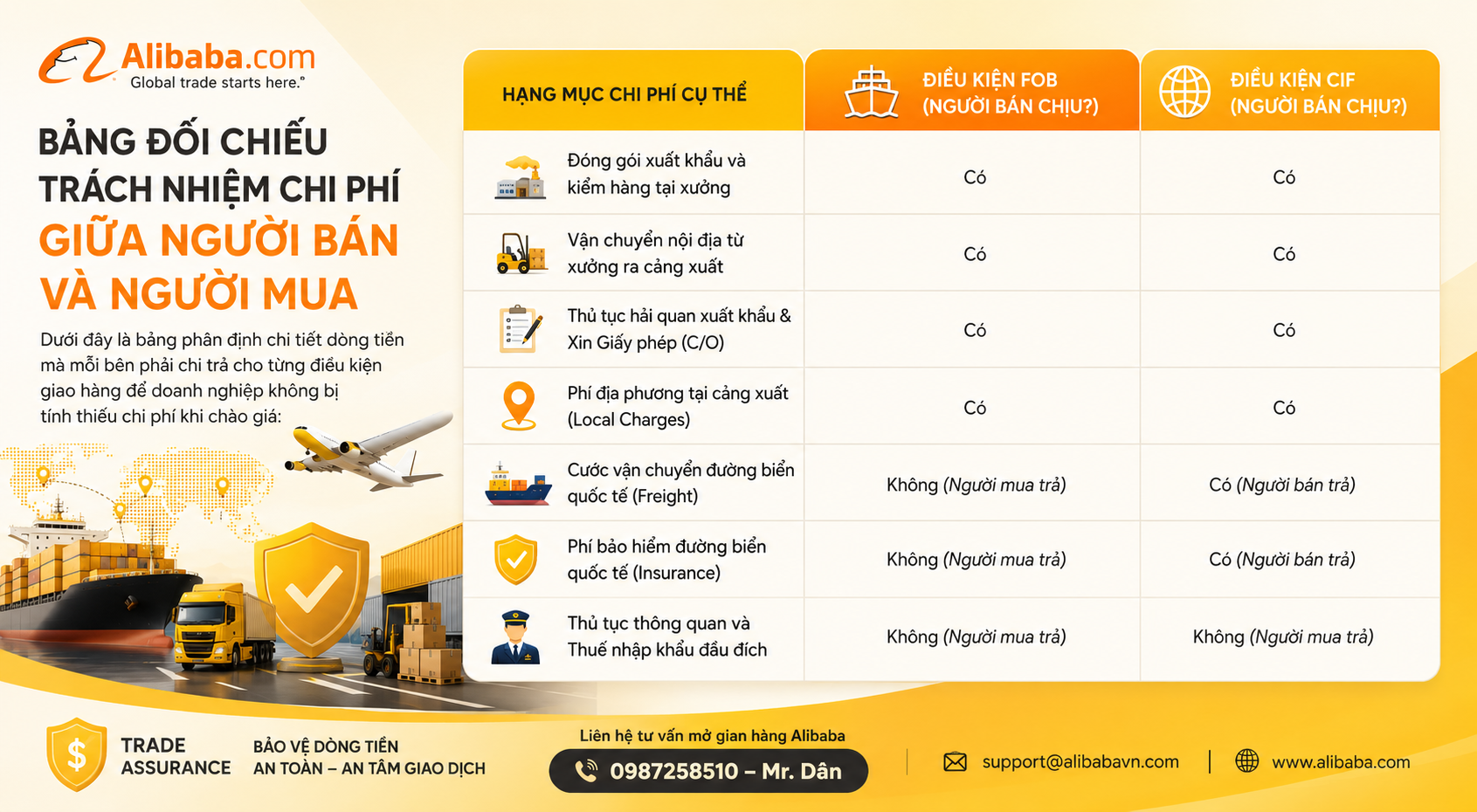
2. Cost Responsibility Reconciliation Table Between Seller and Buyer

Below is a table detailing the cash flow that each party must pay for each delivery condition so that businesses do not undercount costs when bidding:

Distinguishing the nature of FOB and CIF, separating risk transfer points and reviewing additional cost traps helps sellers protect cash flow when exporting through Alibaba.

Detailed cash flow analysis table

3. Potential Risks for Sellers in Each Condition

No delivery conditions are absolutely safe. Each method has potential risk scenarios that the export sales team must master:

Risks for sellers when choosing FOB price:

  • Risk of buyer delay in appointing ship:Because the buyer is the party who has the right to charter the ship, if they cannot find the ship or deliberately postpone the pick-up schedule, your goods will be stored or stored at the port of departure, causing extremely expensive storage costs (Demurrage/Detention).

  • Risk of order cancellation when the goods have arrived at the port:The goods were pulled to the export port but the buyer suddenly encountered financial problems and canceled the contract. At this time, the seller must bear the cost of bringing goods back to the factory and handling the inventory crisis.

  • Risk of being forced to price Local Charges:Due to not having the right to choose the shipping company, the seller is forced to use the shipping agent (Forwarder) designated by the buyer. Many designated forwarders often force sellers to pay Local Charges at Vietnamese ports, which are much higher than the general market average.

Risks for the seller when choosing CIF price:

  • Risk of ocean freight price fluctuations (Ocean Freight Volatility):International shipping rates always fluctuate unpredictably by week or by low/peak season. If you offer a fixed CIF price to customers early on, but on the day of shipping, the freight rate skyrockets, the factory's profit margin will be swallowed up.

  • Risk of incurring costs at the destination port:If the set of export documents (Bill of Lading, C/O, Invoice) is erroneous, leading to goods being detained at the import port for inspection, the seller may be complained by the customer or forced to compensate for storage costs incurred at the foreign terminal due to document delay errors.

  • Responsibility for purchasing correct insurance:The seller is obliged to purchase insurance for the shipment. If you buy the wrong type of insurance or the insurance terms do not cover the correct nature of the goods (for example: fragile goods, agricultural products that are easily moldy), when a loss occurs, the seller will be involved in long legal disputes with the buyer.

4. Should Small Businesses Choose FOB or CIF to Optimize Efficiency?

The choice of conditions depends largely on the experience and capacity of the internal logistics team and the negotiating position of the factory:

Distinguishing the nature of FOB and CIF, separating risk transfer points and reviewing additional cost traps helps sellers protect cash flow when exporting through Alibaba.

Comparison table between FOB AND CIP for small businesses

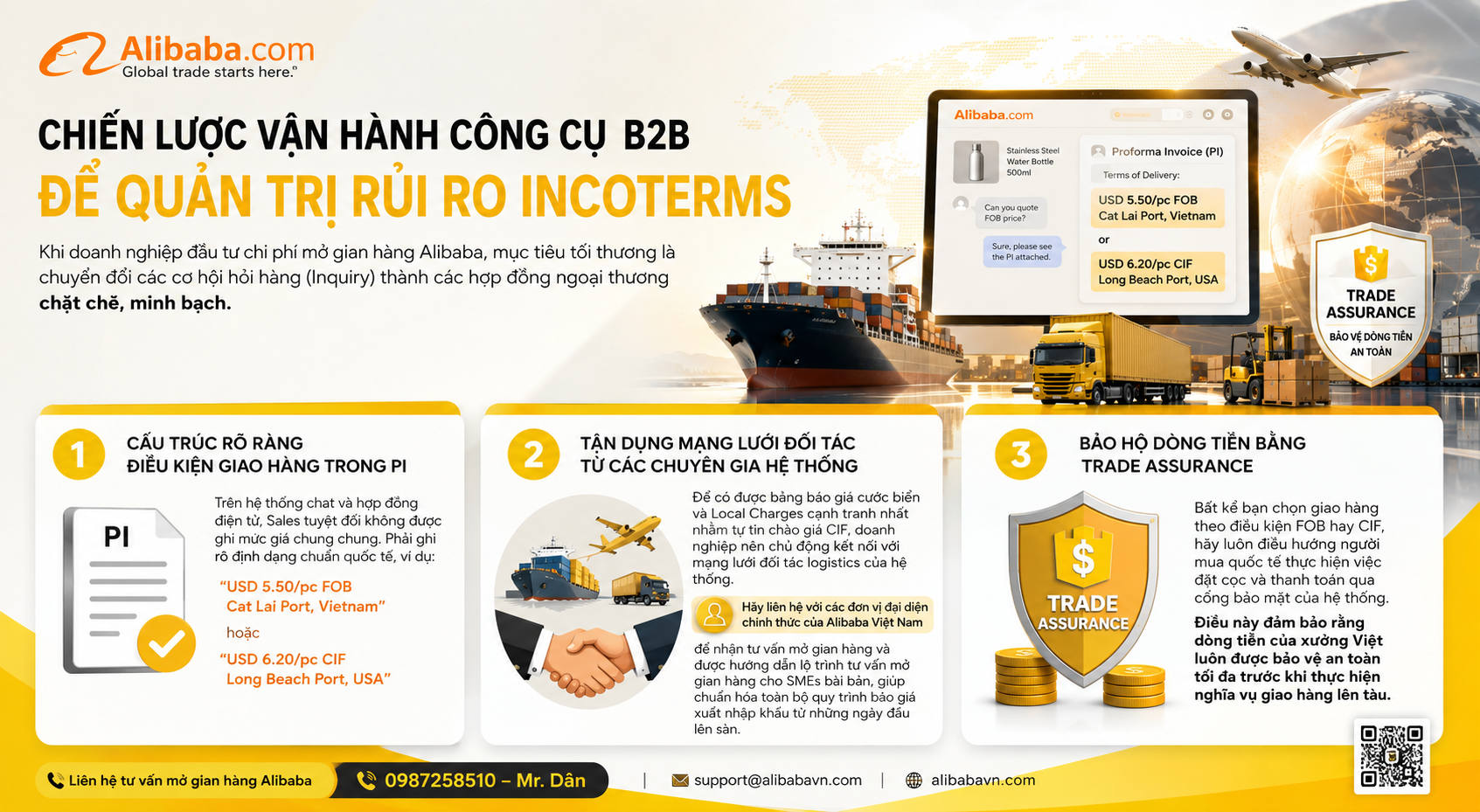
5. Strategy for Operating B2B Tools to Manage Incoterms Risk

When businesses invest in opening an Alibaba booth, the ultimate goal is to convert Inquiry opportunities into strict, transparent foreign trade contracts.

Distinguishing the nature of FOB and CIF, separating risk transfer points and reviewing additional cost traps helps sellers protect cash flow when exporting through Alibaba.

Operational strategy for Incoterms risk management

Learn more about cash flow protection with Trade Assurnace here!

Conclude:FOB and CIF both have distinct advantages and disadvantages. Thoroughly understanding the risk transfer point and accurately dissecting costs not only helps Vietnamese factories avoid international dispute traps, but is also a sharp weapon to help businesses confidently negotiate, optimize profits and break through sustainable export sales on the global trade map.

Contact us for advice on opening a booth - Don't wait another day!

Are you in Dong Nai, Binh Duong or Ho Chi Minh City? COMPANY LIMITEDALIBABA.COMVIETNAM - ALIBABA VIETNAM is ready to support:

  • Head office: 19th Floor, Saigon Center Building, No. 67 Le Loi Street, Ben Nghe Ward, District 1

  • E-mail:[email protected]

  • Phone: +84 0987258510 (Mr. Dan - main consultant)

  • Branch 1: 10th Floor, Becamex Tower, 230 Binh Duong Avenue, Thu Dau Mot, Binh Duong

  • Branch 2: 9th Floor, TTC Plaza, Vo Thi Sau, Thong Nhat Ward, Bien Hoa City, Dong Nai

  • Branch 3:123 Cong Hoa, Ward 12, Tan Binh, Ho Chi Minh City 700000, Vietnam

Call now 0987258510 – Mr. Dan for free consultation, support in opening a booth, optimizing products and exporting plans to the West in 2026. No consultation fee, no commitment, just need you to be ready to act!

Related news

Keyword Research Guide for the Furniture Industry
E-commerce

9/30/2025

Keyword Research Guide for the Furniture Industry

How to find what international customers are searching for and optimize your listings for visibility.

Read More
5 Mistakes to Avoid When Selling on Alibaba
E-commerce

9/21/2025

5 Mistakes to Avoid When Selling on Alibaba

Common pitfalls for new businesses starting out on Alibaba.com.

Read More
INSTRUCTIONS ON HOW TO SELL ON ALIBABA.COM
E-commerce

10/17/2025

INSTRUCTIONS ON HOW TO SELL ON ALIBABA.COM

Are you ready to take your business to the international market? With a seller account on Alibaba.com, you can expand your business reach, reach millions of potential customers globally, and bring your products to the world. Below is a detailed guide to start your selling journey on Alibaba.com.

Read More