
Comparing 5 international B2B platforms for Vietnamese businesses
Comparing five international B2B platforms by buyer profile, order size and total cost, with guidance on choosing the right fit for Vietnamese suppliers.
Ta Thi Minh Phuong
Author
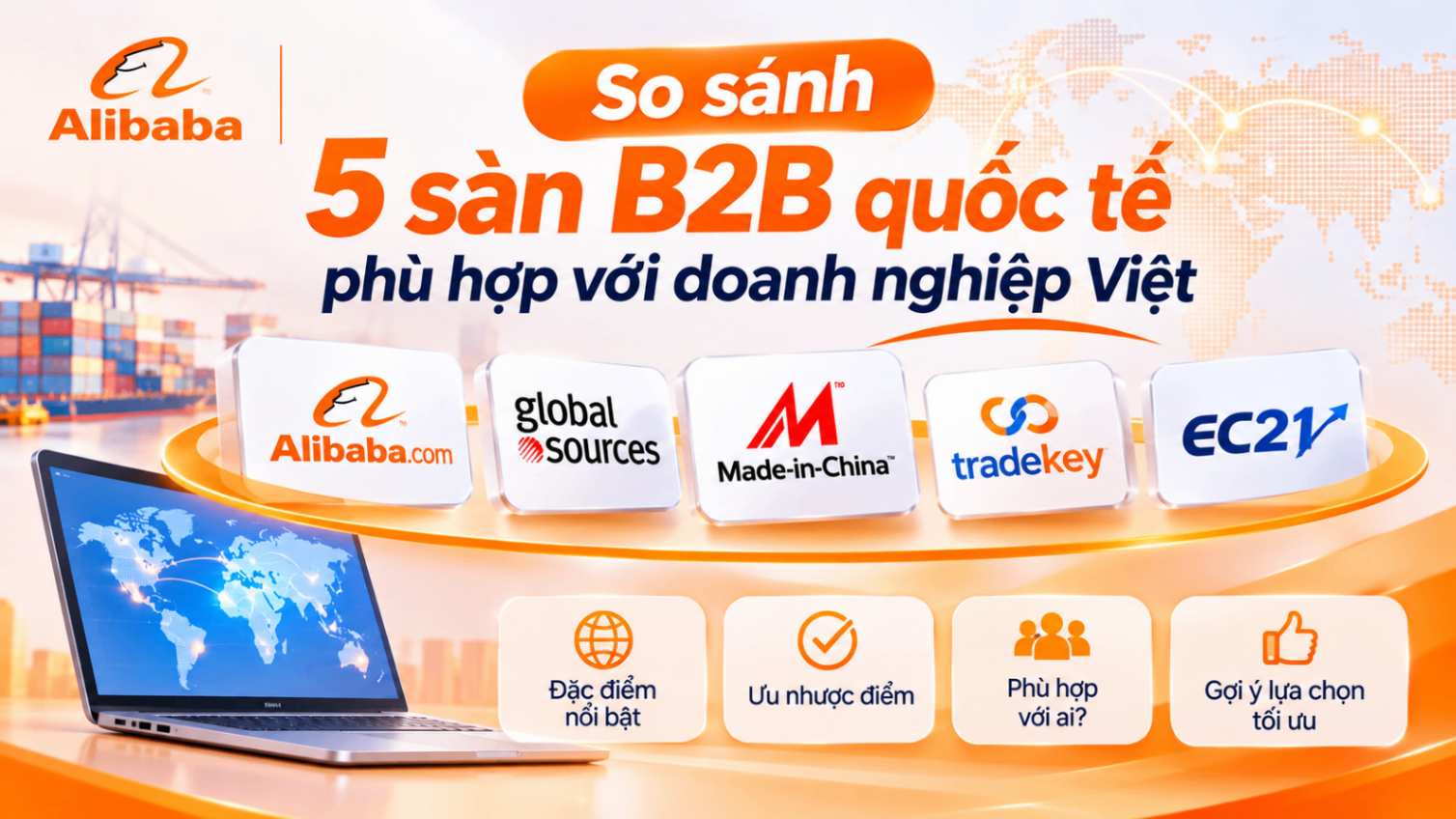
Choosing a B2B platform is not about picking the one with the most visitors. It is about picking the one where the buyers you can actually serve are concentrated. A platform with heavy traffic but mostly small, low-value orders will not suit a factory that needs stable production runs — and the reverse is equally true. This article compares five widely used platforms against the criteria Vietnamese businesses genuinely need to weigh.
1. Five criteria to compare
Buyer profile and geography. Which markets the platform is strong in, and whether buyers are importers or retailers.
Typical order size. Some platforms suit small repeat orders; others suit full container loads.
Depth of supplier verification. Whether the platform runs an independent assessment or relies on self-declaration.
Sales support tools. Search visibility, advertising, request-for-quotation flows and data analytics.
Total cost of ownership. Not just the membership fee, but advertising spend and the staff needed to run the account.
2. Overview comparison table
Platform | Main strengths | Typical buyer profile | Points to note |
|---|---|---|---|
Alibaba.com | Largest scale, multi-industry, complete sales toolkit | Importers, retailers, private-label brands | High competition, needs an advertising budget |
Global Sources | Tied to sourcing fairs, strong in consumer goods | Professional buyers, retail chains | Lower organic search traffic |
Made-in-China | Strong in industrial goods and machinery | Industrial buyers | Buyer base concentrated on Chinese goods |
IndiaMART | Strong in South Asian markets | Domestic Indian and regional buyers | Less suited to exports to Europe and the US |
Europages | European business directory | European buyers looking for new suppliers | Leans toward profile visibility rather than transactions |
The table above is qualitative only. Fees, verification requirements and features on each platform change over time — check them directly before you decide.
3. Which platform suits whom?
Factories new to export, multi-industry: start with the platform carrying the largest search traffic so you can gather market data quickly.
Businesses with a narrow niche and technical products: consider platforms weighted toward industrial goods and professional buyers.
Consumer-goods sellers who need retailers: favour platforms with a dense base of retailers and private-label brands.
Businesses targeting Europe: keep a profile in a European directory alongside your main trading platform.
4. Three questions before choosing a platform
What order size do buyers on this platform typically place, and does that match your minimum capacity?
What will the first 12 months cost, advertising and staff included — and how long can you sustain that before orders arrive?
Who will run the account day to day, and can that person reply within 24 hours?
5. Should you run several platforms at once?
Not for new businesses. One platform run well beats three run half-heartedly.
Open a second only once the first is producing repeat orders and someone owns it specifically.
If you do run several, avoid duplicated content so you do not compete with yourself or dilute your rankings.
Fixed costs multiply with each platform — budget for that before you expand.
6. Five mistakes when choosing a platform
Choosing on a service seller's recommendation without checking the buyer profile yourself.
Comparing membership fees alone, ignoring advertising and staffing costs.
Opening several platforms at once before you have an operating process in place.
Reusing identical content everywhere, so no platform ranks well.
Not measuring after 90 days, so you never learn whether to stop or continue.
7. Frequently asked questions
Which platform is the cheapest? There is no single answer, because the membership fee is only one part. Compare the total 12-month cost, advertising and staff included.
Is any platform completely free? Some directories let you create a free profile, but transaction features are limited. Do not expect steady orders from a free profile.
Should I choose by product category or by target market? Both. Category decides which platform has the right buyers; target market decides which platform has traffic in that region.
Talk to an advisor
ALIBABA.COM VIETNAM CO., LTD — ALIBABA VIETNAM
Head office: 19th Floor, Saigon Centre, 67 Le Loi Street, Ben Nghe Ward, District 1, Ho Chi Minh City
Branch: 10th Floor, Becamex Tower, 230 Binh Duong Boulevard, Thu Dau Mot, Binh Duong
Branch: 9th Floor, TTC Plaza, Vo Thi Sau Street, Thong Nhat Ward, Bien Hoa, Dong Nai
Call 0987258510 — Mr. Dân for a free consultation and a detailed B2B platform comparison for your industry.
Related news

9/30/2025
Keyword Research Guide for the Furniture Industry
How to find what international customers are searching for and optimize your listings for visibility.
Read More →
9/21/2025
5 Mistakes to Avoid When Selling on Alibaba
Common pitfalls for new businesses starting out on Alibaba.com.
Read More →
10/17/2025
INSTRUCTIONS ON HOW TO SELL ON ALIBABA.COM
Are you ready to take your business to the international market? With a seller account on Alibaba.com, you can expand your business reach, reach millions of potential customers globally, and bring your products to the world. Below is a detailed guide to start your selling journey on Alibaba.com.
Read More →