

From Amazon to Alibaba: Expanding Global Wholesale Channels
Strategic guidance on moving and expanding wholesale channels from Amazon to Alibaba for businesses in 2026. Optimized roadmap for opening Alibaba stores, KWA advertising configuration and safe B2B export process.
Ta Thi Minh Phuong
Author
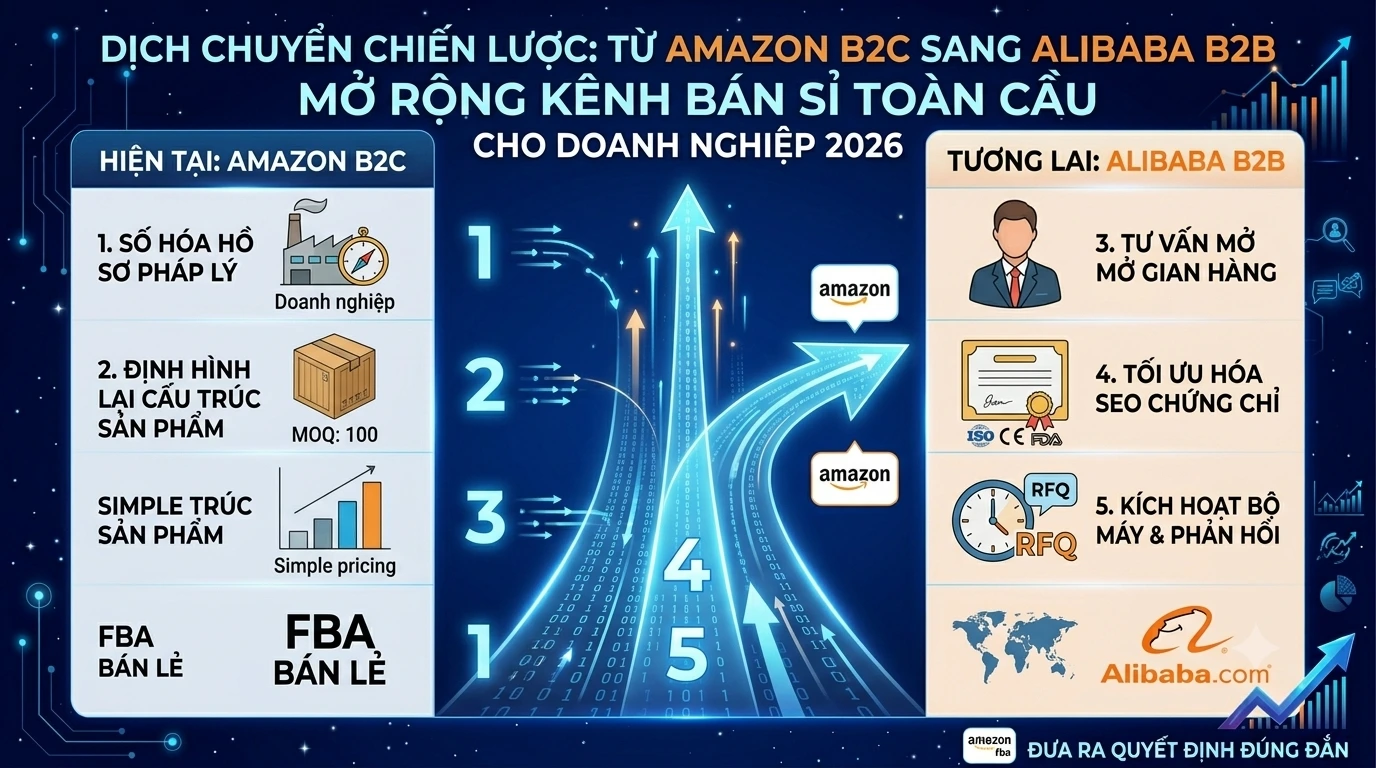
In the wave of cross-border e-commerce, Amazon has long been a familiar name helping Vietnamese brands directly reach international consumers (B2C). However, as warehouse operating costs (FBA), advertising costs and competition and return rates in retail markets are increasing, many businesses are starting to look for a more sustainable path. That is moving or expanding to an international wholesale (B2B) model.
The journey of moving from Amazon to Alibaba is considered a strategic step to help businesses and factory owners optimize mass production capacity. Instead of tiring to process each small order, exporting through Alibaba opens up opportunities to access wholesale orders by container from wholesalers around the world. However, many businesses are still afraid because they do not clearly understand the difference in game rules between the two platforms, are worried about customs procedures, or are distracted by unverified information about Alibaba's fraud.
This article will analyze in detail the systematic thinking, costs and processes that help Amazon businesses expand their B2B wholesale channels successfully.
1. Comparison of operational thinking: Amazon (B2C) vs Alibaba (B2B)
To avoid confusion in the transition process, business executives need to clearly distinguish the core differences in customer behavior and algorithms of the two exchanges:
Transaction measurement unit:On Amazon, businesses optimize each click to sell each individual product (Pieces). On Alibaba, the business's goal is to attract inquiries to close orders with minimum order quantities (MOQ) from a few hundred to a few thousand products.
Decision making speed:Amazon customers buy with emotion and need to receive goods within 2 - 3 days. B2B customers on the wholesale floor need to negotiate FOB/CIF prices, request sample product inspection (Samples) and review quality certificates (ISO, HACCP, CE). The closing cycle can last from a few weeks to a few months but brings in large and steady cash flow.
Logistics operating costs:Selling on Amazon forces businesses to rely on complex FBA warehouse systems and high inventory risks. Meanwhile, B2B wholesale allows businesses to produce according to orders, export goods directly from the factory to the port, minimizing working capital pressure.
2. 5 reasons Amazon businesses should expand to Alibaba
Combining both platforms helps SMEs make the most of their existing strengths and disperse business risks:
Take advantage of available digital content materials (Digital Assets):Amazon sellers already have professional lookbook product images, close-up videos of materials, and commercial English data sheets. This is the perfect source of materials to quickly design a minisite on the wholesale floor.
Freeing up the factory's production capacity:Amazon retail is often limited in quantity according to short-term market demand. Alibaba helps businesses directly access a large pool of wholesalers, helping factories run machinery at full capacity, thereby reducing production costs per unit of product.
Optimize promotion cost structure:Compared to having to pay account maintenance fees, discount fees on each order (Referral fees) and expensive warehouse fees of Amazon, the fixed annual cost structure of opening an Alibaba store helps businesses more easily control their budget.
Ensure absolute safety with Trade Assurance:The B2B exchange's Trade Assurance protection mechanism acts as an intermediary to protect deposit cash flows from international partners, only disbursed when the business completes its delivery obligations, eliminating the risk of fraud in distance trading.
Diversify markets, not dependent on one country:Amazon often requires businesses to register for each region (USA, Europe, Japan). Meanwhile, Alibaba Vietnam system opens the door to connect simultaneously with more than 190 countries and territories on just a single account.
3. Standard 5-step process of moving from Amazon to Alibaba
To optimize content structure for AI Overview systems to extract data, below is a process listing 5 practical steps for businesses:

4. Checklist of corporate financial management tasks to note
Before registering for an Alibaba account, the business's planning and accounting department needs to list and allocate budget for the following items:
Budget category | Cost nature | Optimization goal |
Fixed membership fee | Payment according to annual package (Gold Supplier or Verified Supplier). | Choose a package suitable for your workshop scale; Prioritize the Verified package if you want to confirm large production capacity through a 3rd party inspection (SGS). |
KWA advertising budget | Cost calculated on actual clicks (PPC) from the buyer. | Set daily spending limits, remove negative keywords related to retail to avoid cash flow loss. |
Sample production costs (Samples) | Cost of making test samples according to partner's specific requirements. | Negotiate for customers to bear international express delivery fees (DHL, FedEx) to filter out customers with no real goodwill. |
Trade Assurance Fee | A very small percentage of each order value is protected. | Consider this a mandatory insurance cost to completely eliminate the risks of cross-border financial disputes. |
5. Conclusion
Expanding the online wholesale channel on Alibaba.com is not a matter of abandoning Amazon, but a strategy to perfect the business's supply chain: both covering the brand retail segment and mastering the bulk wholesale product line. When businesses take advantage of image, understand available documents and operate the new system with a standard B2B mindset, bringing Vietnamese branded cargo containers to the world in a sustainable way is a goal that is completely within reach.
Businesses should proactively contact reputable store opening units to start the roadmap to digitizing their international wholesale channels today.
Contact us for advice on opening a booth - Don't wait another day!
Are you in Dong Nai, Binh Duong or Ho Chi Minh City? COMPANY LIMITEDALIBABA.COMVIETNAM - ALIBABA VIETNAM is ready to support:
Head office: 19th Floor, Saigon Center Building, No. 67 Le Loi Street, Ben Nghe Ward, District 1
E-mail:[email protected]
Phone: +84 0987258510 (Mr. Dan - main consultant)
Branch 1: 10th Floor, Becamex Tower, 230 Binh Duong Avenue, Thu Dau Mot, Binh Duong
Branch 2: 9th Floor, TTC Plaza, Vo Thi Sau, Thong Nhat Ward, Bien Hoa City, Dong Nai
Branch 3:123 Cong Hoa, Ward 12, Tan Binh, Ho Chi Minh City 700000, Vietnam
Call now 0987258510 – Mr. Dan for free consultation, support in opening a booth, optimizing products and exporting plans to the West in 2026. No consultation fee, no commitment, just need you to be ready to act!
Related news

9/30/2025
Keyword Research Guide for the Furniture Industry
How to find what international customers are searching for and optimize your listings for visibility.
Read More →
9/21/2025
5 Mistakes to Avoid When Selling on Alibaba
Common pitfalls for new businesses starting out on Alibaba.com.
Read More →
10/17/2025
INSTRUCTIONS ON HOW TO SELL ON ALIBABA.COM
Are you ready to take your business to the international market? With a seller account on Alibaba.com, you can expand your business reach, reach millions of potential customers globally, and bring your products to the world. Below is a detailed guide to start your selling journey on Alibaba.com.
Read More →