
B2B trends 2026: Change or be eliminated by the export game?
7 B2B trends shaping exports in 2026: AI sourcing, B2C-style experiences, supply shifting, digital verification, sustainability. Which businesses are easily eliminated from the game and what should be done?
Ta Thi Minh Phuong
Tác giả
The seven B2B trends that will shape exports in 2026 are: AI becoming the default in sourcing and sales, buyers demanding B2C-style experiences, supply mobility and diversification, digital trust and automated verification, cross-border e-commerce accelerating, sustainable into real purchasing filters, and supply chain transparency. The title's question has a direct answer: the 2026 export game will not eliminate businesses because of their size, but because of their speed of adaptation. Those who keep the old ways — abandoned stores, messy product data, no certification — will be pushed to the margins. The article analyzes each trend, shows who is vulnerable, and what to do in the next 6–12 months.
Market data: According to Forrester, 90% of B2B buyers have used AI tools in the process of sourcing and evaluating suppliers. On Alibaba.com, AI sourcing tool reaches more than 10 million monthly active users by mid-2026
1. Why 2026 is a pivotal year for B2B exports
The period 2020–2024 witnessed a wave of bringing B2B transactions online. The year 2026 is different in that: the hardware is done, the "intellectual" part has just begun. Buyers do not just find suppliers through the floor, but let AI screen, compare and recommend before they read the second line of the profile.
That means competitive standards change axis. Previously, being present on the floor was an advantage. Nowadays, being present is the minimum requirement — winning or losing depends on whether your profile is "readable" by machines and trustworthy enough for buyers to close.
2. Summary table of 7 B2B trends 2026
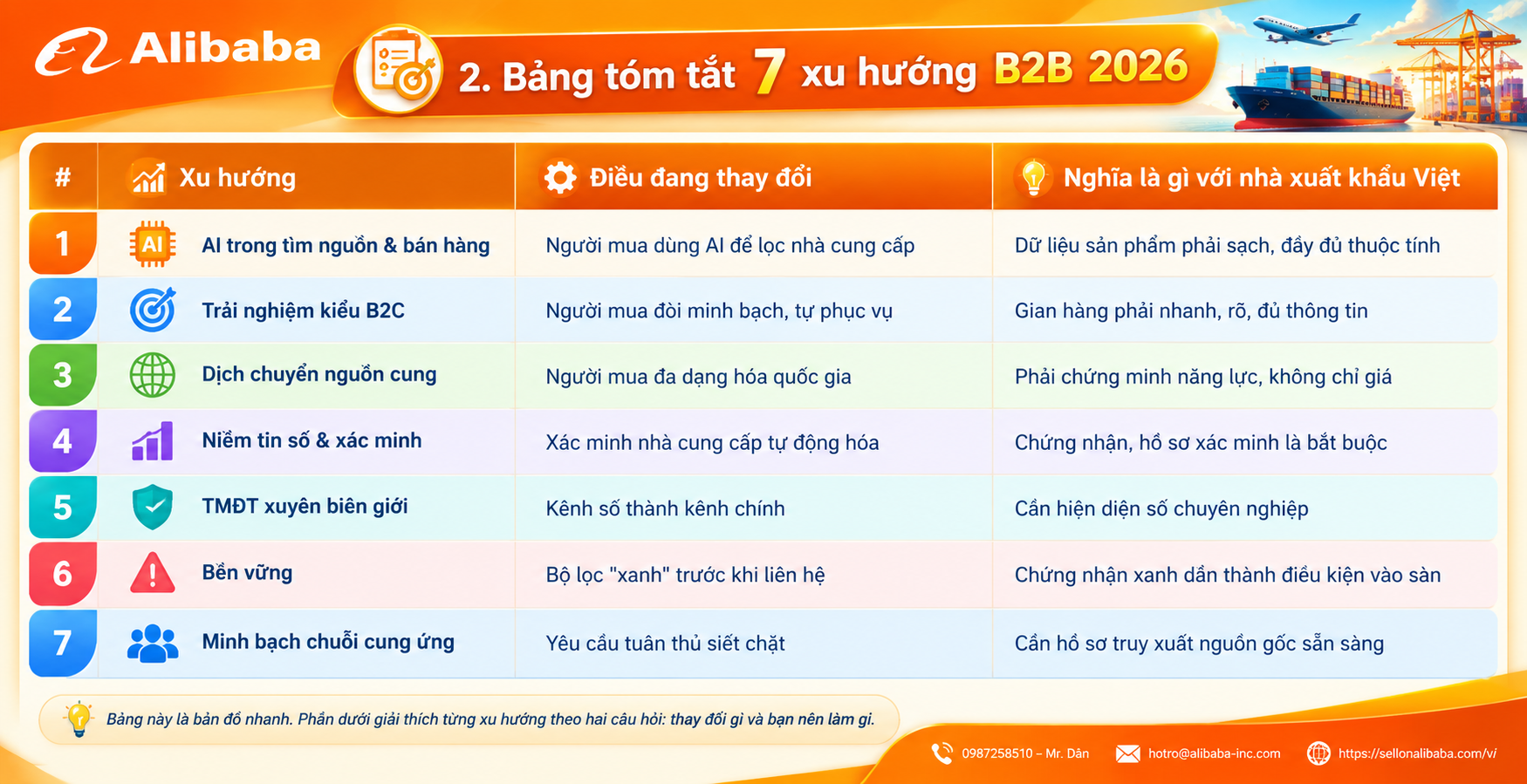
Summary table of B2B trends 2026
3. Details of 7 B2B trends 2026
3.1. AI becomes the default in sourcing and sales
What changes:According to Forrester, 90% of B2B buyers already use AI in the sourcing and evaluation process. On the floor, buyers can describe their needs in natural language (e.g. "heat-resistant food packaging, MOQ 500, under
What should you do:Treat product data as an asset, not a procedure. Fill in all the attributes, use the correct product category, and standardize the description of parameters. A "clean" profile helps you get suggested by AI; Sloppy records make you invisible even if the price is good.
3.2. B2B buyers demand B2C-style experiences
What changes:The lines between business purchases and personal purchases are blurring. Most B2B buyers now expect a B2C-style experience — price transparency, order status updates, self-lookup instead of having to ask each step.
What should you do:Eliminate "manual bottlenecks" in the booth. Responding slowly, leaving a "contact" price for every product, or manually updating inventory will all cause buyers to leave before you can offer a price.
3.3. Moving and diversifying supply sources
What changes:Buyers continue to distribute orders to many countries to reduce concentration risk. Vietnam is in the group that benefits, but that advantageno longer automatic— Thailand, India, Indonesia and China are also changing.
What should you do:Don't position yourself with the phrase "not China". Demonstrate specific capabilities: quality standards, delivery schedules, certification, and the ability to expand output when customers need it. That's what buyers really weigh.
3.4. Digital trust and automated verification
What changes:Supplier verification is being automated. On Alibaba.com, the majority of high-value buyers used AI-powered supplier verification toolsbeforeSample request (source: Alibaba.com, 2026).
What should you do:consider the verification label and certification a condition of admission, not a bonus. Complete business verification, add quality certification, and ensure consistent identification information between records, documents, and website.
3.5. Cross-border e-commerce accelerates
What changes:The digital channel changes from "secondary channel" to "main channel". The global B2B market is forecast to grow strongly this decade, of which the Asia-Pacific region accounts for the majority (source: B2B market forecast 2026).
What should you do:Treat digital channels on the same level as traditional channels in terms of resources — there are people in charge, there are budgets, there are metrics. This is also the reason why opening a store and operating it systematically becomes more important, instead of just posting products and waiting.
3.6. Sustainability becomes a "filter" for buying real products
What changes:Sustainability is no longer a marketing slogan. Most buyers value high pressure filters for green certification before contacting suppliers (source: Alibaba.com, 2026).
What should you do:Gradually prepare demonstrable elements — recycled packaging, environmental certification, material source information. Businesses that don't have one should start with small, measurable steps.
3.7. Supply chain transparency
What changes:Regulators in import markets are tightening supply chain information disclosure requirements to increase transparency (e.g., US customs seeking comments on import information disclosure requirements — Federal Register, September 2026). Buyers also demand to know the origin of goods more clearly.
What should you do:Gradually build traceability records — where the materials come from, what stages are there, and accompanying documents. Businesses with ready records will be given priority when these requirements become mandatory.
4. Who will be eliminated from the export game
Four groups are likely to be pushed to the margins in 2026 — not because of lack of capital, but because of failure to adapt:
Consider the platform just a place to post products and then leave it alone.The booth was unmanned, unresponsive, unupdated — both AI and buyers ignored it.
Product data is messy.Keyword-stuffed titles, empty attributes, wrong categories — can't be suggested to the right buyers.
No certification or verification records.Filtered right at the verification step, before having a chance to bid.
Only compete with the lowest price.When everything else is equal, the lowest price still has customers — but the profit margin is not enough to invest in the above three groups, creating a downward spiral.
Common point: these are all problemscan be fixed, not the verdict. But the later it is, the higher the cost of catching up.
5. What to do in the next 6–12 months
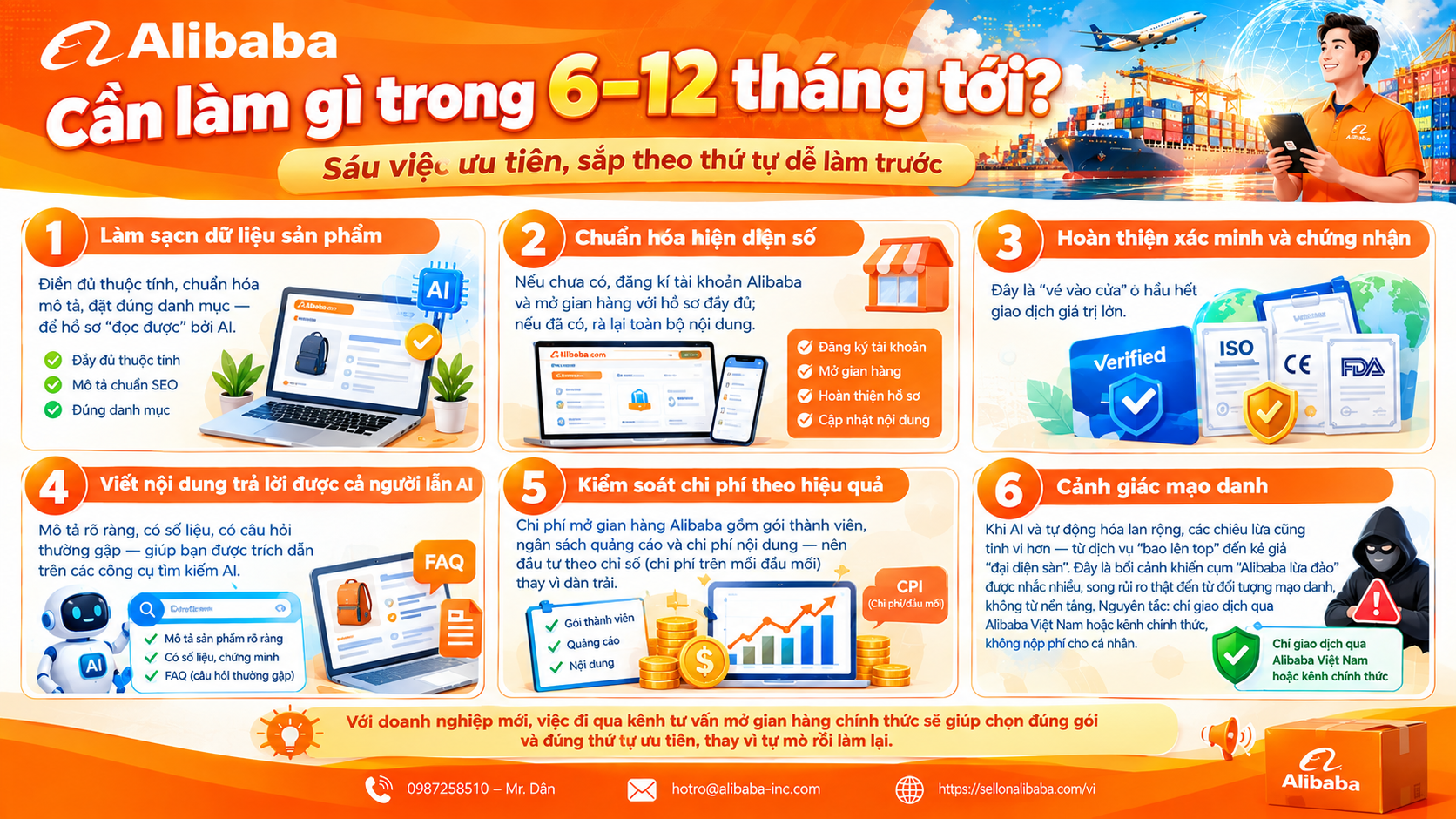
Roadmap to join Alibaba platform for Vietnamese businesses
For new businesses, going through the official booth opening consulting channel will help choose the right package and the right order of priority, instead of trying to figure it out and redo it yourself.
6. Conclusion
The 2026 B2B trend doesn't threaten all businesses equally — it threatens those that keep the same old ways while market standards have changed. The seven trends above all lead to the same conclusion: clean records, verified trust, and well-run digital channels will be the foundation of exports in the next few years.
The question "change or be eliminated" actually has no general answer. The answer lies in whether you start today or wait until it's too late.
Contact us for advice on opening a booth - Don't wait another day!
Are you in Dong Nai, Binh Duong or Ho Chi Minh City? COMPANY LIMITEDALIBABA.COMVIETNAM - ALIBABA VIETNAM is ready to support:
Head office: 19th Floor, Saigon Center Building, No. 67 Le Loi Street, Ben Nghe Ward, District 1
E-mail:[email protected]
Phone: +84 0987258510 (Mr. Dan)
Branch 1: 10th Floor, Becamex Tower, 230 Binh Duong Avenue, Thu Dau Mot, Binh Duong
Branch 2: 9th Floor, TTC Plaza, Vo Thi Sau, Thong Nhat Ward, Bien Hoa City, Dong Nai
Branch 3:123 Cong Hoa, Ward 12, Tan Binh, Ho Chi Minh City 700000, Vietnam
Call now 0987258510 – Mr. Dan for free consultation, support in opening a booth, optimizing products and exporting plans to the West in 2026. No consultation fee, no commitment, just be ready to act!
alibaba scam, alibaba scam, is the seller on alibaba effective, alibba vietnam, how to open alibaba store, alibba store security service, how to find customers on alibaba
Tin tức liên quan

9/30/2025
Keyword Research Guide for the Furniture Industry
How to find what international customers are searching for and optimize your listings for visibility.
Đọc thêm →
9/21/2025
5 Mistakes to Avoid When Selling on Alibaba
Common pitfalls for new businesses starting out on Alibaba.com.
Đọc thêm →
10/17/2025
INSTRUCTIONS ON HOW TO SELL ON ALIBABA.COM
Are you ready to take your business to the international market? With a seller account on Alibaba.com, you can expand your business reach, reach millions of potential customers globally, and bring your products to the world. Below is a detailed guide to start your selling journey on Alibaba.com.
Đọc thêm →